Pages
Featured Post
Now Available: The Brutal Blade of Bruno the Bandit Vol. 8!
Long overdue, but worth the wait, The Brutal Blade of Bruno the Bandit Vol. 8 is now available! Gaze in wonder at the cover by Clint ...
Friday, March 31, 2023
The Reading List: Hugo Award Winner "The Demolished Man" by Alfred Bester
Tuesday, February 28, 2023
The Reading List: Stoker Award 1987 - Misery by Stephen King
The Bram Stoker Award is presented by the Horror Writers Association for superior achievement in horror writing. It was first presented in 1987, and in that inaugural year saw two books take the prize for best novel, Stephen King's "Misery" and Robert McCammon's "Swan Song" (more on the latter at a later date). Since then, it sees to have reflected the very best that horror writing has to offer, and nearly everything King has written has managed to find its way onto the nominee list.
In the 1980's, Stephen King was arguably doing his best work. Some of his most iconic works, from "Firestarter" to "Cujo", "Pet Semetary", "It" and "The Dark Tower" originated in this decade, during which he prolifically proved his mastery of horror and dark fantasy. However, towards the end of the decade there seemed to be another thematic thread rising in his work, and I would argue that it began with "Misery".
One reason King's work has resonated so strongly with his fans is his handling of character. In the horror genre at the time, there were few writers who gave their characters such depth and believability, where most authors seemed to prefer to focus on the lurid or the grotesque. The terrible things that happen in King's novels have so much more impact because they happen to people, not just animated stick figures on the page.
Up until "Misery", the draw of King's work was definitely the monstrous; the vampires of "Salem's Lot", the ghosts of "The Shining", the devil dog of "Cujo", or any of his many deranged psychics. With "Misery", King seemed to be exploring a new direction, setting aside his supernatural beginnings in favor of a quieter, more psychological kind of horror. It was probably a gamble when his fanbase had bought in on the bloody promise of "Christine" and "Carrie", but it was clear that King wanted to explore new ground in his writing, and it was a gamble that paid off.
"Misery" has its share of the monstrous, but the thing that makes it work is that the monster is entirely human. It is an exploration of solitude, toxic fandom, creativity (and, by extended metaphor, addiction) that takes horrible shape in the person of Annie Wilkes. Behind her facade of adoration and support, she hides the face of the deadly consequences of the things we create. The thing that looks like it is helping you is, in the end, going to kill you. King lays out in very visceral imagery a picture of a writer who is bound by the persona he has created. He is literally bound and hobbled by his own work. Just as Paul Sheldon tries to escape from the restrictions that writing the chronicles of Misery Chastain has put him under, so Stephen King seemed to be trying to escape the limitations and tropes of his own work by creating a new monster that is so much more subtle, and so much more relatable, than the "famous monsters" cast he had played with up until now.
The proof of the value in this work, of course, lies not in the awards it won at the time, but in the way it has endured. Beyond the book, beyond even the admittedly excellent movie, "Misery" has had an influence down the line to the present day. It paved the way for many a psychopathic villain to follow and even, I would argue, set the tone for the recent trend towards "quiet horror" seen in the work of directors like Ari Aster and Ti West. Only last Hallowe'en, I was treated to a new stage interpretation of the novel, done with some very creative set design and rendered with nearly as much impact as the original work.
Since "Misery", King has of course gone on to master this more literary form of horror with ensuing novels like "Dolores Claiborne", "The Dark Half" and "Gerald's Game", and even woven the same kind of character development into more outright horror novels such as "Bag of Bones", "Dreamcatcher" and "Black House". It is in part that depth that has kept his work from becoming stale and repetitive. The supernatural elements in his work, when they are present, are often secondary to the character's arcs, and rightly so. "Misery" changed a lot in King's work, for both the writer and for the reader, and overall (for this reader at least) for the better.
"Misery" is available at Amazon, or if you prefer, you can read it for free at archive.org.
Monday, February 6, 2023
The Value of Stepping Outside Your Comfort Zone
Over a year ago, I was approached by a creator, Osmar Ramos-Caballero, looking for an inker for his book, Las Bravas. I was hesitant at first to take on the job. I've always tried to maintain a kind of realism in my work, having cut my artistic teeth on the artists of Conan and Master of Kung-Fu, and followed up learning from the work of artists as varied as Frazetta, Vallejo, Wrightson, Bart Sears and Frank Cho. The style of the pages he was offering me were very different from what I was used to and I wasn't sure if I could adapt to the work.
However, a job is a job, and to be honest, I needed the income at that time, so I took on the job and tried to do the best I could with it.
My first mistake was to try to adapt Osmar's work to my own style, layering a more realistic style of rendering over his simpler page designs, a style with lots of hatching, feathering and shading. It didn't work, and I'm glad I didn't try to show him those pages.
When it comes to inking, part of the challenge is always to try to respect the penciler's work while adding some of your own style. Osmar's work has a more cartoonish, grafitti-inspired style, with lots of large closed shapes, very stylized forms, and a dramatic sense of action. His pages are as much about design as they are about illustration; everything is not always technically perfect, but it always works. Stylistically, it reminds me of the early comic work of Alejandro Jodorowsky.
So, stepping back, I decided to back off on my attempts on interpretation and give his original work more room to breathe. I tried again, sticking more closely to his own sense of form and motion, and just allowing my use of line weights to bring out the depth of the panels. This time it worked much better. So much so, in fact, that Osmar asked me to follow up with lettering and coloring on this pages.
Osmar colors his original pages in marker, so there's lots of visible brush stroke and somewhat muted colors in the pages. However, I could see that he was aiming for the kind of vivid colors that you see in grafitti or in Meso-American art. So I decided that this was again a case of "less is more" and went for mainly flat color with some simple cut-and-grad shading instead of risking overwhelming his art with unnecessary subtle shading. And let me tell you that learning how to letter a comic in Spanish was no easy task. Lettering in any form has never been my strong suit, and trying to do it with Spanish characters only made it more complicated for me. Still, with the very handy lettering tools in Clip Studio Paint and the Komika font from Dafont, I was able to get the job done.
If I hadn't taken a chance on that first set of pages, I would not have had the successful collaboration with Osmar that I've had for the past year, and I would missed the chance to work on these very enjoyable pages. Sometimes it's helpful to ignore that nagging little voice that tells you not to do something and take a chance on expanding your creative horizons; step outside your comfort zone and see what happens.
As of the date of this post, I've completed inking, color and lettering on three volumes of Las Bravas for Osmar, as well as dozens of pages of pinups and character portraits. Volumes 1 & 2 are available on Amazon right now, while Volume 3 will be arriving shortly. If you've got Kindle Unlimited, they're free to read. If not, they're still reasonably priced. They're in Spanish, of course, but they do a Spanish-English guide at the end that may be very helpful. And besides, in any language, they're pretty to look at...if I do say so myself!
Wednesday, February 1, 2023
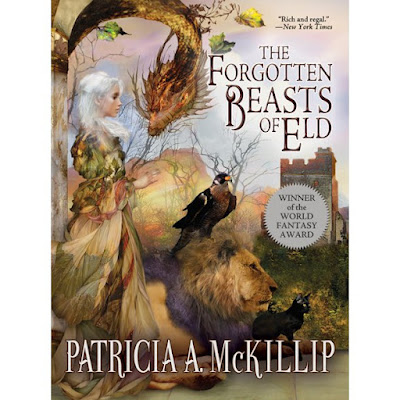
The Reading List: World Fantasy Award 1975 - The Forgotten Beasts of Eld by Patricia A. McKillip
In Stephen King's memoir, "On Writing" he recounts a conversation with Amy Tan in which he asked her if there was a question she was never asked in Q&A sessions, and her response was "They never ask about the language."
This line has stuck with me since I encountered it, and it has made me more mindful of my reading since then; I pay much more attention to the way an author uses language, and it is one of the criteria by which I determine the quality of an author or a work.
McKillip's book "The Forgotten Beasts of Eld" stood out to me like few others for its use of language. Written in the language of high fantasy (think Tolkien and C.S. Lewis), this story reads more like a poem than prose; her language has a lyrical idealism that is only found in the very best fantasy literature. Witness this piece of "dialogue" from the novel:
"I thought of you with your hair silver as snow all through that cold, slow journey from Sirle. I felt you troubled deep within me, and there was no other place in the world I would rather have been than in the cold night riding to you. When you opened your gates to me, I was home."
I cannot imagine many recent authors I've read even attempting a passage like that with a straight face, but McKillip carries off the entire book in that manner.
Now, I'll make a confession...no surprise to anyone who knows me...I don't generally like fantasy fiction. Oh, sure, I enjoy the Lord of the Rings as much as any reader, but when it comes to most modern fantasy, I tend to shy away from it. For one thing, there's hardly such a thing as a fantasy "novel" any more. There's fantasy sagas, epic series, cycles and chronicles aplenty, thousands of pages requiring a major commitment of time to read with no guarantee that the story will ever even be finished (yes, I'm looking at you GRRM). On top of that, I can't seem to handle the names in fantasy novels; there's far too many hyphens and apostrophes in there for me to be comfortable with them. When an author starts telling me the saga of L'erin-Medd'ezzath, archmage of Tir Cinealta, I'm out and heading for a stack of Donald Westlakes.
It's very refreshing, then, when I find an occasional and rare fantasy novel that engages me the way this one did. "Forgotten Beasts" is not so much a read as it is an experience, like a fugue or a reverie. It stimulates the imagination with visions of high fantasy and removes the reader from their personal context into the ficton of the novel. It's characters are ideal figures, yet somehow still relatable, and still fantastic enough to inspire grand mental pictures of the kinds of world depicted by only the best fantasy artists.
This is a book for not only those who love high fantasy, but also those who love good literature. It is the kind of writing that much fantasy fiction aspires to be, and in achieving that transcends its genre in a way that echoes more popular authors whose work is considered more widely known.
"The Forgotten Beasts of Eld" is, of course, available to purchase on Amazon, or if you'd prefer to read it for free, there's several copies available to borrow at Archive.org.
Tuesday, January 17, 2023
New Blog Feature: The Reading List
Monday, November 21, 2022
Reading List: "The Complete Fiction of H.P. Lovecraft" - Knickerbocker Classics Edition
I have read Lovecraft's fictional output in its entirety several times, in several formats. Whether it's for reference, or just for pure enjoyment, nothing competes with pulling out one of my favorite tales from old Uncle Theobald (among my favorites being Cool Air, Pickman's Model, and The Music of Erich Zann).
So it was inevitable that I would have to get a really good compendium of the complete works to give pride of place on my bookshelf. I was given an Amazon gift card a few years ago and knew that the stars were right to choose THE Lovecraft collection for my library.
There are many to choose from, some being garish, some being very expensive and some being woefully incomplete. There are electronic editions aplenty (including one very nice one I found that also contained the complete collaborative works, juvenilia, poetical works and links to audiobooks of most of his fiction, all for under a buck!), and you can even read most of it for free online at hplovecraft.com. Still, it's hard to compare those with the tactile thrill of having a physical copy of the work that you can hold and admire.
After going through quite a few of the offerings on Amazon, the best one for my money ended up being the Knickerbocker Classic Edition of The Complete Fiction of H.P. Lovecraft. For a very reasonable price you get a slipcovered hardcover edition that is beautifully printed on high quality paper with tasteful cover art that celebrates the pulp roots of the work while still being somewhat dignified. In fact, one of the things that drew me to this edition was that the slipcase art reminded me of Virgil Finlay's Weird Tales illustrations.
The stories are complete and appear to be printed in order of publication (I haven't fully verified this). Of course this means that the edition contains over 1100 pages. That, plus the hardcover and slipcase, means that this is a weighty tome that you could probably wield to fend off a shoggoth. It looks and feels nice and handles well. I've had my copy on my bookshelf for a couple of years and refer to it often, and it has yet to show any signs of wear.
For the ardent Lovecraft fan, this is a volume worth adding to that eldritch library; probably the next best thing to sporting a copy of the Necronomicon itself.
Monday, November 7, 2022
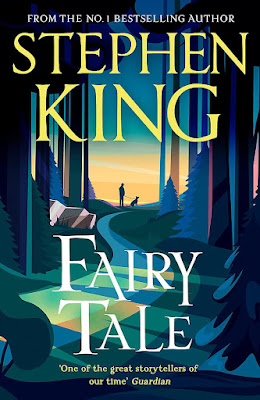
Reading List: "Fairy Tale" by Stephen King
Given my history with King's work, I think you'll understand that it's especially disappointing when I have to say that there's something he's written that I just don't care for. It's happened before...I am know for my dislike of the novel "Pet Sematary", and I found myself utterly indifferent to some of his more recent books such as "The Institute." I am aware that no writer can hit them all out of the park, but King has written so many great books that I find it hard to believe he could ever write something that doesn't hit home with me.
Unfortunately, that was the case with "Fairy Tale", a rare occasion where I actually had to force myself to finish the book, under some kind of sunk cost fallacy. Even the chapter illustrations by Gabriel Rodriguez and Nico DeLort weren't enough to get me invested in this story.
I mean...it's not a BAD book, objectively speaking. Even the worst Stephen King story is better than most modern fantasy and/or horror literature. It's just that it's not up to the standard King has set for himself with his own body of work.
King is, of course, best known as a horror writer, and while this story contains horrific elements, it is chiefly a fantasy novel, as the title would suggest. Similar to previous King works it contains a youthful protagonist whose adventures take place across multiple realities. Unlike previous King works, the story is largely flat and lifeless without many of the signature narrative tricks and techniques that make his work so appealing. There's nearly none of the dramatic foreshadowing that make his stories so suspenseful, and none of the Dickensian character exploration that bring his figures to memorable life. Like far too many fantasy novels, it's just a straightforward dungeon-crawl of a novel where "this happened, then that happened, then the other thing happened" and so on until the end.
There were some good moments to be found in the book, of course. It IS Stephen King, after all. I enjoyed the nods to Lovecraft (how could I not?) and I like the fact that, like most of his work, this story could be tied in to his Dark Tower mythology. There were a couple of moments in the book that were genuinely touching. Overall, though, it was a lackluster effort that explored narrative territory that I thought was better handled in books like "Eyes of the Dragon", "Talisman" and the Dark Tower stories.
I supposed it's possible that this was a deliberate experiment on King's part to see if he could tell a story without falling back on his typical writerly tricks. If that's the case then, at least for this reader, it didn't work.
There are some readers, perhaps those who steep themselves in high fantasy more than I do, that will enjoy this book, and fans of that genre will probably find lots in here to appreciate. For my money, it is just a plain story that lacks any resonance beyond the initial reading, nor even functions as the agent of moral instruction that characterized the traditional fairy tale. Oh well...they can't all be winners.